How does my website get found on Google and in AI assistants?
A website gets found on Google and in AI assistants when every page answers a visitor’s question in its first sentences. That text must sit in the page itself: as far as we know today, AI assistants read nothing that only loads later in the browser. Tripscha Digital builds every page this way, with a visible date. Nobody can honestly promise a ranking. As of October 2026.
Google and AI assistants read what is in the page itself.
As far as we know today, the assistants from OpenAI, Anthropic and Perplexity only read what is in the page straight away. Anything that only loads later in the browser, they do not see.
According to Google’s own statement from May 2026, its AI answers draw on the same pages as normal search. There is no special trick for them.
What counts is the same as for visitors: a page that answers their question in the first sentences, with a date and a source.
One question, one page, and the answer in the first paragraph.
People search with questions, not menu items: “What does the first consultation cost?”, “Are you open now?”. Every important question gets its own page.
The answer paragraph sits directly below the heading, names the business, with a number, a place and a date, and can be read on its own. That makes it easy to quote.
A business that has the same name, the same address and the same number everywhere is recognised reliably: on the website, in its Google Business Profile and in directories.
What Tripscha Digital builds into every website for this.
Part of every project
Basic Google optimisation
Structure, headings, search descriptions and fast loading are part of every project. Google and AI assistants can read every text directly.
We do not promise a ranking in search results.
Technology
No WordPress and no plugins that someone has to maintain. Every text is part of the page itself, nothing loads in later.
Measurement
Before we build, we agree with you what counts as an enquiry. After launch we compare enquiries per week, before and after.
Without cookies.
On top of that, every statement carries a visible date. That way visitors and search engines can see how current it is.
Nobody can honestly promise a place on Google or a mention by an assistant.
Search systems change, and assistants’ answers vary. A position or a timeframe cannot be promised.
Something else can be. Everything that makes you findable in your region is built in, and anyone who finds you is one click away from an enquiry.
After launch, we measure how many enquiries come in per week, before and after.
What one question per page looks like: one of our websites.
This tax firm’s website answers each concern on its own page, with the answer in the first paragraph every time.
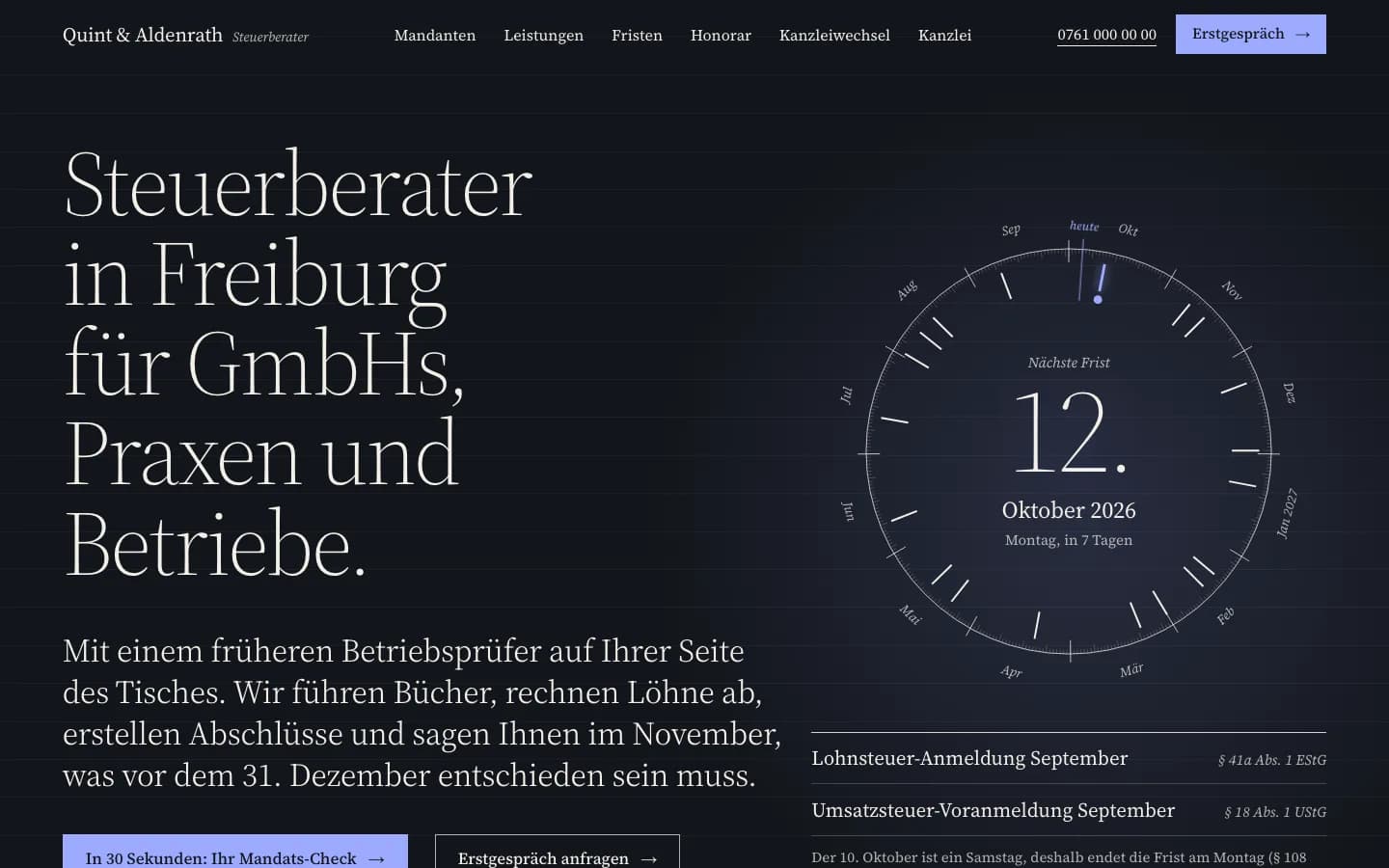
Quint & AldenrathOpen site
The site knows what day it is. The next deadline, the deadline calendar and the timeline for switching firms are calculated from today.
Headline
The headline says who the firm is for and where. No “Welcome”, no slogan.
Deadline
The next deadline is calculated from the rules and cites the legal provision.
Enquiry
The enquiry button sits in the header and stays visible while you scroll.
An example from our portfolio: Quint & Aldenrath.
One conversation, then you see your site.
Intro call: 30 minutes, by video or in Villingen-Schwenningen. Then we build your prototype, and only then comes the fixed price.
Earliest intro call: one working day after your enquiry